Roll Parameters for Self-Adhesive Labels — What You Need to Know
If you’re ordering labels in rolls for the first time, or switching from sheet labels, the roll parameter questions on an order form can look more complicated than they are. This is a quick rundown of what each parameter means and why it matters.
Core Inner Diameter
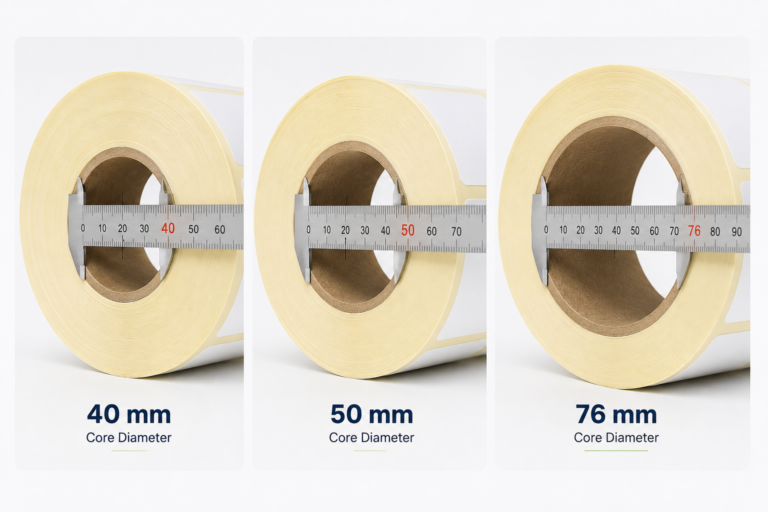
The core is the cardboard tube at the centre of the roll — the same principle as a kitchen towel or baking paper roll. It serves four practical purposes: it gives the label material something to wind around, stabilises the roll during transport, protects the innermost labels, and fits onto the spindle of a printer or label applicator.
We offer three standard core sizes: 40 mm, 50 mm, and 76 mm.
To find out which size your device requires, check the device specifications under “Media Specifications” — the relevant field is usually labelled “Core Inner Diameter” or “Roll ID.”
Roll Outer Diameter
The outer diameter is the total diameter of the finished roll, measured from the outside edge through the centre. It matters for two reasons: a roll that’s too large won’t fit in your printer or applicator, and a roll that’s too small means more frequent changeovers.
Outer diameter is directly linked to the number of labels on a roll — the more labels, the larger the roll. If you have a specific requirement (for example, you need exactly 500 labels per roll because that matches your production batches), you can specify that instead of a diameter. We’ll calculate the resulting roll size from there.
Check your device specifications under “Media Specifications” for the field “Max Roll Diameter” or “Roll OD” to find the maximum your equipment can accept.
Roll Width
The width of the roll depends on the label size, the distance between several rows and how many labels are next to each other on the material. As a standard, you should consider the width of the label + 2mm of liner on each side.
Winding Direction
Winding direction describes the orientation of the labels on the roll — specifically, which edge of the label comes off the roll first, and whether the labels face outward or inward.
There are 8 standard winding configurations, split into two categories:
- Labels wound on the outside of the roll (the standard option for most printers and applicators)
- Labels wound on the inside of the roll (less common, required by some applicator setups)
Within each category, the specific winding number determines whether the top edge, bottom edge, left edge, or right edge of the label feeds first. This needs to match how your applicator picks up and applies the label, or how your printer feeds the roll.

When specifying the label dimensions, indicate the edge that comes off the roll first as the first number — therefore, a 40×58 mm label and a 58×40 mm label would be wound differently on the roll.
Label Gap and Pitch (for automatic application)
If labels will be applied automatically, your applicator may also require information about label pitch (the distance from the leading edge of one label to the leading edge of the next) and gap (the space between individual labels). These are typically defined when the label die is created, and the values need to match what the applicator expects.
The standard gap for most labels is 4 mm, but applicator manufacturers sometimes specify tighter tolerances. If your applicator has specific requirements here, let us know at the order stage.
Does Any of This Matter If You Apply Labels by Hand?
If you’re applying labels manually, most of these parameters are irrelevant — we’ll wind the rolls in a practical way for hand application and you don’t need to specify winding direction or pitch.
The one parameter that still matters is labels per roll: if you want rolls of a specific count to match your workflow (e.g. one roll per production batch), tell us and we’ll roll accordingly.
What does affect price in all cases is the total number of rolls. Rolling 10,000 labels into 200 rolls of 50 requires significantly more post-processing time than rolling the same quantity into 10 rolls of 1,000. If small roll counts aren’t a strict requirement, larger rolls are the more economical choice.
Not sure what parameters your equipment needs? See the machine manual in the “Media Specifications” section, contact your printer or application machine specialist, or send us a photo and we’ll try to make the right choice together.